
Five years after a hair transplant, many patients can still have natural-looking hair growth in the transplanted areas. However, a hair transplant does not necessarily stop future hair loss from the patient’s original, non-transplanted hair.
The long-term appearance depends on factors such as the patient’s underlying hair-loss type, donor hair quality, surgical planning, graft survival, age, genetics, and whether ongoing hair-loss treatment is appropriate. The American Academy of Dermatology notes that transplanted hair can provide permanent results, while hair around the transplanted area may continue to thin over time.
Check Your Hair Transplant Cost Instantly
Table of Contents
Introduction
Many people researching hair transplantation ask the same question:
“What will happen to my hair 5 years after a hair transplant?”
Patients often see impressive before-and-after photographs showing results at 6 or 12 months. But long-term results are just as important. A successful hair transplant should be planned not only for today’s appearance but also for how the hairline, donor area, and surrounding natural hair may change over the following years.
Five years after surgery, some patients may still enjoy a stable and natural-looking result. Others may notice thinning in their original hair, changes in density, or a need to discuss additional treatment.
Understanding the difference between transplanted hair and native hair is essential when evaluating long-term hair-transplant results.
What Happens to Transplanted Hair After 5 Years?
In many patients, transplanted follicles can continue producing hair years after surgery. The American Academy of Dermatology describes hair transplantation as capable of producing permanent, natural-looking results, although it also emphasizes that hair loss and thinning can continue in other areas.
However, “permanent” should not be interpreted as a guarantee that every transplanted follicle will remain unchanged forever.
Long-term outcomes can vary between individuals. One published follow-up study of FUT patients found that transplanted hair density had decreased to varying degrees at four years compared with the one-year assessment, illustrating that long-term density can change and that graft longevity is not identical for every patient.
What this means for patients
At five years, transplanted hair may:
- Continue growing normally
- Remain relatively stable in density
- Appear thinner because of changes in surrounding native hair
- Show some reduction in density in certain patients
- Require assessment if significant unexpected shedding occurs
The long-term result should therefore be evaluated as a whole scalp outcome, not simply by looking at the transplanted grafts.
Key Takeaway: Many transplanted hairs can remain long-term, but individual results vary, and the overall appearance can change as natural hair loss progresses.
Does Hair Transplant Stop Hair Loss Permanently?
No. A hair transplant redistributes hair; it does not necessarily stop the underlying hair-loss process.
This is one of the most important concepts patients should understand before surgery.
During transplantation, follicles are moved from a donor area to an area affected by hair loss. The procedure does not automatically prevent genetically susceptible, non-transplanted follicles from continuing to thin.
The NHS specifically warns that hair can continue to thin around the transplanted area and that transplant planning should consider how the hair may look as time passes.
This is why a good long-term treatment plan may involve more than surgery.
Must Read: 8 Lifestyle Changes That Cause Hair Loss
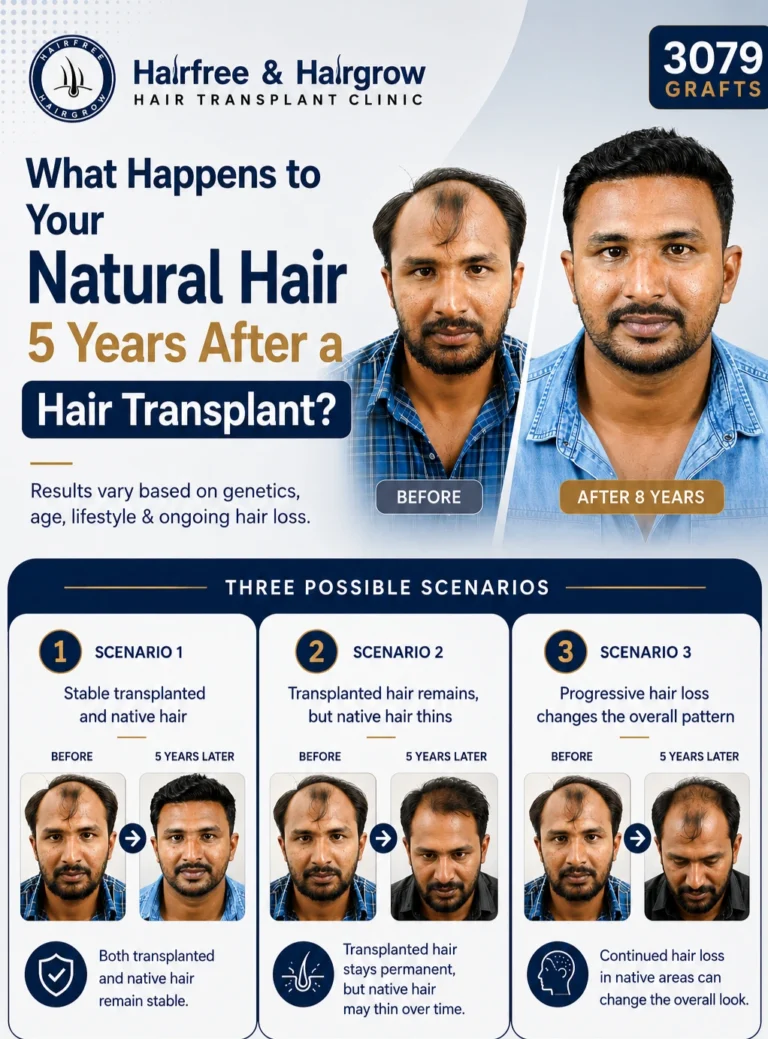
What Happens to Your Natural Hair 5 Years After a Hair Transplant?
Your native hair can continue to change after transplantation.
For patients with androgenetic alopecia, the underlying tendency toward progressive miniaturization may continue. As a result, the transplanted area may remain relatively stable while the surrounding natural hair becomes thinner.
This can create several different long-term appearances:
Scenario 1: Stable transplanted and native hair
The patient maintains both transplanted and surrounding natural hair reasonably well.
The result may continue to look natural and balanced.
Scenario 2: Transplanted hair remains, but native hair thins
The transplanted hair may remain visible while the hair behind or around it becomes thinner.
This can make the transplanted area appear more prominent.
Scenario 3: Progressive hair loss changes the overall pattern
A patient may develop additional recession or thinning that was not present when the original surgery was planned.
In such cases, the patient may need another evaluation to determine whether medical treatment or additional transplantation is appropriate.
Key Takeaway: A hair transplant can restore density in selected areas, but it does not necessarily prevent future loss of the patient’s original hair.
Will a Hair Transplant Look Natural After 5 Years?
A well-planned hair transplant can continue to look natural years after surgery.
Long-term natural appearance depends on factors including:
- Appropriate hairline design
- Correct graft distribution
- Donor-area planning
- Graft placement and angulation
- Matching graft density to the patient’s characteristics
- Anticipating future hair loss
- Appropriate patient selection
- Surgical technique and execution
The American Academy of Dermatology emphasizes that the surgeon’s experience and ability to understand hair loss play an important role in achieving natural-looking results.
A hairline that looks natural at one year may not remain aesthetically balanced if significant native hair loss occurs behind it.
That is why future hair-loss planning is an important part of the initial consultation.
Do You Need Hair Loss Treatment After a Hair Transplant?
Sometimes, yes.
Hair-loss medication may be recommended for appropriate patients because it can help slow or reduce ongoing loss of native hair. The American Academy of Dermatology specifically notes that medication may help patients maintain their results by slowing or preventing further hair loss and thinning.
However, whether medication is suitable depends on the patient’s diagnosis, medical history, sex, age, medications, contraindications, and treatment goals.
Patients should discuss medical treatment with a qualified dermatologist or physician rather than starting or stopping medication on their own.
Important: A hair transplant and medical hair-loss treatment are not necessarily alternatives. In selected patients, they may form part of the same long-term hair-restoration strategy.
What Should You Do If Your Hair Is Thinner 5 Years After a Hair Transplant?
If your hair looks thinner several years after surgery, do not immediately assume that you need another transplant.
A specialist should first determine the following:
- Which areas have lost density
- Whether transplanted follicles are still growing
- Whether native hair is continuing to thin
- Whether the donor area remains adequate
- Whether there is an underlying scalp condition
- Whether medical treatment could help
- Whether another procedure is actually necessary
A consultation can compare current photographs with previous records and examine the donor and recipient areas.
In some patients, medical management may be more appropriate than another surgery.
In others, a carefully planned second session may be considered.
Must Read: What Medications Should Be Taken After a Hair Transplant?
Can You Have a Second Hair Transplant After 5 Years?
Yes, some patients may be candidates for another hair-transplant procedure several years after the first operation.
However, the decision should not be based solely on the number of years since the first procedure.
The surgeon should evaluate:
Donor Hair Availability
There must be sufficient suitable donor hair to support another procedure.
Current Hair-Loss Pattern
The pattern may have changed considerably since the original transplant.
Previous Graft Distribution
A second procedure should take into account how the first grafts were distributed.
Future Hair Loss
The treatment plan should consider what may happen in the future rather than simply increasing density today.
Overall Hair Characteristics
Hair caliber, curl, color, density, and scalp characteristics can all affect the visual result.
Key Takeaway: A second hair transplant may be possible after five years, but donor supply and future hair-loss planning are more important than the time interval alone.
What Happens to the Donor Area After 5 Years?
The donor area is where follicles are harvested during hair transplantation.
In FUE, individual follicular units are extracted from the donor area. In FUT, a strip of scalp is removed, and the wound is closed, leaving a linear scar.
Five years later, the donor area’s appearance depends on:
- Number of grafts removed
- Distribution of extraction
- Donor density
- Surgical technique
- Patient’s hair characteristics
- Future donor-area hair loss
A well-planned procedure should avoid unnecessary depletion of the donor region.
This is particularly important because donor hair is a limited resource.
Hair Transplant 5-Year Timeline: What Can Patients Expect?
First Year
The transplanted follicles go through the normal post-operative growth cycle. Temporary shedding can occur, followed by new growth. The NHS states that full results are generally visible within approximately 10 to 18 months, while the AAD notes that many patients see meaningful results around 6 to 9 months, with some requiring 12 months.
Years 1–2
The result becomes easier to assess. Hair caliber, density, and the relationship between transplanted and native hair become more apparent.
Years 2–3
For many patients, the transplant itself has reached a more mature appearance, while the underlying hair-loss pattern continues to be monitored.
Years 3–4
Changes in native hair may become more noticeable in patients with progressive hair loss.
Year 5
At five years, the focus should shift from simply asking whether the transplant “worked” to assessing the following:
- Long-term density
- Transplanted-hair stability
- Native-hair progression
- Donor-area condition
- Overall aesthetic balance
- Need for ongoing treatment
Key Takeaway: Five years is an important point for evaluating the long-term relationship between transplanted hair, native hair, and the donor area.
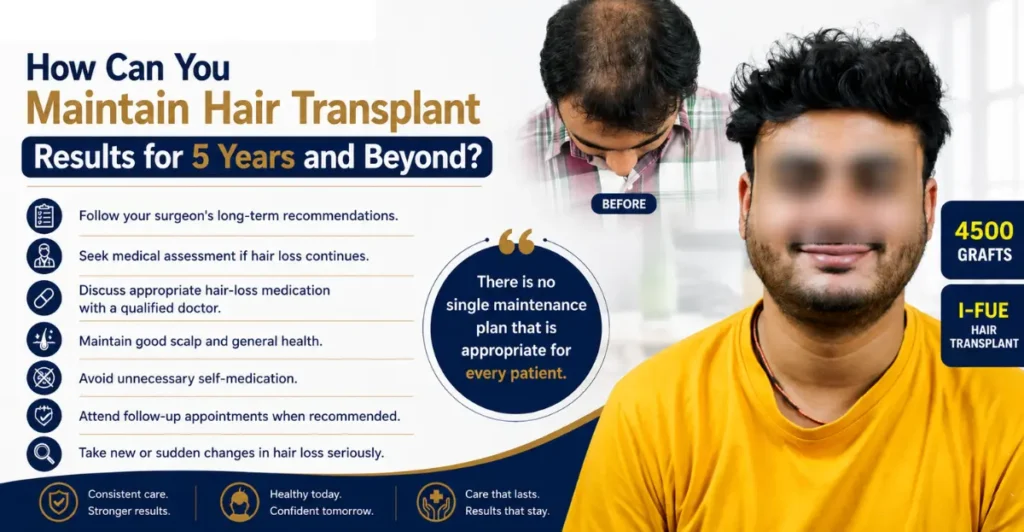
How Can You Maintain Hair Transplant Results for 5 Years and Beyond?
Long-term maintenance depends on the individual diagnosis and treatment plan.
Useful steps may include:
- Follow your surgeon’s long-term recommendations.
- Seek medical assessment if hair loss continues.
- Discuss appropriate hair-loss medication with a qualified doctor.
- Maintain good scalp and general health.
- Avoid unnecessary self-medication.
- Attend follow-up appointments when recommended.
- Take new or sudden changes in hair loss seriously.
There is no single maintenance plan that is appropriate for every patient.
How to Choose the Right Hair Transplant Clinic in Bangladesh
Why Choosing the Right Clinic Matters
A responsible hair transplant clinic should focus on the following:
- Proper medical assessment before surgery
- Experienced and qualified hair-transplant professionals
- Individualized graft and hairline planning
- Safe donor-area management
- Appropriate surgical technique based on the patient’s needs
- Clear information about expected results and limitations
- Post-operative instructions and follow-up care
- Transparent communication about treatment and costs
For patients in Dhaka and from other parts of Bangladesh, Hair Free and Hair Grow Clinic Bangladesh can be considered a destination for hair restoration consultation and treatment. Before proceeding, patients should have a proper consultation to assess their hair-loss pattern, donor area, expected graft requirement, medical history, and long-term treatment goals.
FAQ
Transplanted hair can provide long-lasting or permanent results for many patients, but individual outcomes vary. Native hair around the transplanted area can continue to thin, which may change the overall appearance.
Yes, hair loss can occur for different reasons, and transplanted hair density may change in some patients over time. A clinical evaluation is needed to determine whether the change involves transplanted follicles, native hair, or another condition.
Not necessarily. Some patients maintain a satisfactory result for many years, while others may need additional treatment because of progressive native hair loss. A second procedure should only be considered after assessing donor reserves and future hair-loss risk.
No. Hair transplantation restores hair in selected areas but does not necessarily stop the underlying process causing native hair loss. Medical treatment may be recommended for suitable patients.
The transplanted hair may remain while the surrounding native hair becomes thinner, potentially affecting the overall density and appearance. A doctor can assess whether medical treatment, observation, or further transplantation is appropriate.
Final Thoughts
For many patients, the transplanted hair can remain a valuable and natural-looking part of their overall hair density. But the long-term result is not determined by the transplanted grafts alone.
The biggest factor is what happens to the native hair around the transplant.
That is why the best hair-transplant strategy is not simply to create the densest possible result today. It should also consider the patient’s likely future hair-loss pattern, donor-hair limitations, and long-term maintenance needs.