
The donor area in a hair transplant is the part of the scalp from which surgeons harvest healthy hair follicles and move them to areas affected by hair loss. In most scalp hair transplants, donor follicles are primarily taken from selected areas at the back and sides of the scalp because these regions are generally more resistant to the miniaturization associated with androgenetic hair loss.
However, not every hair at the back or sides of the head is automatically suitable for transplantation. A qualified hair-transplant specialist must evaluate the donor area’s density, follicular-unit characteristics, hair caliber, stability, scalp condition, and future hair-loss pattern before deciding how many grafts can be safely harvested.
The donor area is one of the most important factors determining how much hair can be restored. Because donor hair is a limited resource, careful donor management is essential for both the current procedure and possible future hair loss.
Check Your Hair Transplant Cost Instantly
Table of Contents
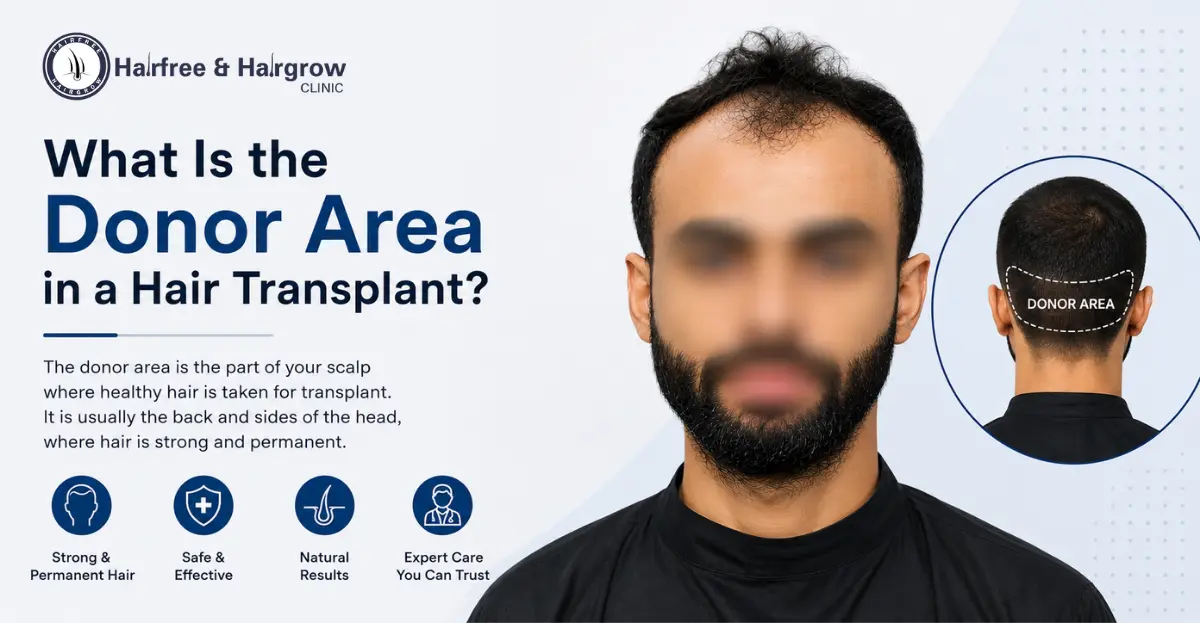
What Is the Donor Area in a Hair Transplant?
The donor area is the region of the scalp where hair follicles are selected for transplantation.
The area receiving those follicles is called the recipient area. During a hair transplant, follicular units are harvested from the donor area and implanted into carefully planned areas affected by hair loss.
In most patients, the principal scalp donor area is located around the back and sides of the head. These areas tend to contain follicles that are more resistant to androgen-related miniaturization than follicles in typical balding regions. This characteristic is commonly described through the concept of donor dominance.
Simple example
If a patient has a receding frontal hairline:
Donor area: Back and sides of the scalp
Recipient area: Receding frontal hairline
Procedure: Suitable follicular units are harvested from the donor area and transplanted into the recipient area.
The objective is not simply to remove as many grafts as possible. The goal is to use the available donor supply strategically while maintaining a natural-looking donor area.
Where Is the Donor Area Located?
The donor area is generally found around the occipital and parietal regions, which correspond broadly to the back and sides of the scalp.
However, the boundaries of a safe donor area are not identical for every patient. The location and stability of donor follicles can vary depending on age, genetics, hair-loss pattern, and conditions such as retrograde alopecia.
Professional guidance recommends assessing the donor area carefully rather than assuming that all hair outside the visibly bald region is permanent.
The donor area may include:
- Occipital scalp
- Parietal scalp
- Selected areas around the sides of the scalp
- In selected cases, non-scalp donor sources such as beard or body hair
Scalp hair is generally preferred when suitable because its characteristics may be more compatible with scalp restoration. Beard and body hair may have different calibers, growth characteristics, and appearances, so their use requires careful clinical planning.
What Is the Safe Donor Area?
The safe donor area refers to the portion of the donor region considered relatively stable against future androgenetic hair loss.
It is important to understand that “safe” does not mean that every follicle in this region is guaranteed to remain unchanged forever.
The boundaries of the safe donor area can vary between patients, and professional guidance recommends assessing factors such as family history, scalp examination, and signs of progressive miniaturization before harvesting grafts.
A study assessing donor areas in Bangladeshi men also demonstrated variation in donor-zone density and proposed limited, standard, and extended donor areas rather than treating the entire back and sides of the scalp as one identical zone.
Key takeaway
A donor area is not simply “the hair at the back of your head.” It must be evaluated for long-term stability before grafts are harvested.
Why Is the Donor Area So Important?
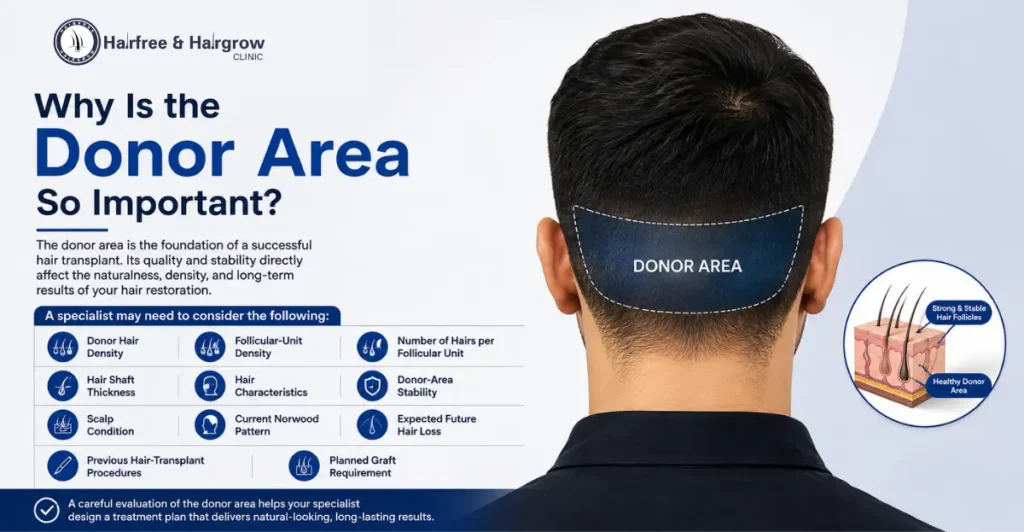
The donor area determines how much usable hair is available for restoration.
Unlike hair that can grow back naturally after a normal haircut, harvested follicular units are removed from their original location. This means the donor supply must be managed carefully.
A specialist may need to consider the following:
- Donor hair density
- Follicular-unit density
- Number of hairs per follicular unit
- Hair shaft thickness
- Hair characteristics
- Donor-area stability
- Scalp condition
- Current Norwood pattern
- Expected future hair loss
- Previous hair-transplant procedures
- Planned graft requirement
Trichoscopic assessment can help evaluate donor hair density, follicular-unit density, and hair-shaft diameter before surgery. These measurements are useful when estimating the appropriate donor supply and extraction limits.
How Is the Donor Area Assessed Before a Hair Transplant?
A proper donor assessment should happen before deciding how many grafts a patient needs.
1. Donor Density
The specialist assesses how many follicular units are present within a defined area.
Higher donor density may provide greater graft availability, while lower density can limit the amount that can be harvested safely.
2. Hair Caliber
Thicker hair shafts can provide greater visual coverage than finer hair.
This means two patients with similar graft counts may not achieve identical visual density.
3. Follicular-Unit Composition
A follicular unit may contain one, two, three, or more hairs.
The number of hairs within each follicular unit affects the total amount of coverage available from a given number of grafts.
4. Donor Stability
The specialist must determine whether the donor region itself is likely to remain stable.
Hair affected by progressive miniaturization may not be appropriate for harvesting simply because it currently appears healthy.
5. Scalp Condition
The scalp should be evaluated for conditions that could affect surgical planning or healing.
6. Future Hair Loss
A good donor assessment considers not only today’s hair loss but also what the patient’s hair pattern may look like in the future.
This is particularly important for younger patients or patients with progressive hair loss.
How Many Grafts Can Be Taken From the Donor Area?
There is no single graft number that is safe for every patient.
The amount that can be harvested depends on donor density, donor-area size, hair characteristics, extraction pattern, previous procedures, and the patient’s long-term hair-loss risk.
Research on donor-area assessment demonstrates substantial variation between individuals. One study of 580 Indian men found different follicular-unit densities across donor regions and emphasized that donor supply should be assessed rather than assumed.
A common mistake is to ask the following:
“How many grafts can I get?”
A better question is
“How many grafts can be safely harvested while preserving my donor area’s appearance and future options?”
That distinction is essential for responsible hair-transplant planning.
What Happens During FUE in the Donor Area?
In FUE, or follicular unit excision, individual follicular units are extracted from the donor area using a small punch.
The extracted grafts are then prepared and implanted into the recipient area.
FUE does not remove a continuous strip of scalp. Instead, individual extraction sites are distributed across the donor region.
Because each extraction creates a small wound, the distribution and number of extractions matter. Excessive or poorly planned harvesting can produce visible thinning or patchy donor depletion.
A well-planned FUE donor area should aim for:
- Appropriate extraction density
- Even distribution
- Preservation of remaining hair
- Avoidance of unstable donor regions
- Long-term donor-area aesthetics
What Happens to the Donor Area After FUE?
Immediately after FUE, tiny extraction sites may be visible in the donor region.
As healing progresses, these sites generally become less noticeable.
The final appearance depends on factors such as the following:
- Number of grafts harvested
- Extraction pattern
- Donor density
- Punch characteristics
- Patient’s hair characteristics
- Healing response
- Whether the donor area was overharvested
The goal is to maintain sufficient remaining density so that the donor region continues to look natural.
Can the Donor Area Become Thin After a Hair Transplant?
Yes. Donor-area thinning can occur if too many grafts are removed or if extraction is poorly distributed.
This is commonly referred to as donor depletion or overharvesting.
Recent clinical literature highlights donor depletion as a potential complication, particularly when large graft numbers are attempted despite insufficient donor density or when extraction limits are exceeded.
Signs of excessive donor harvesting may include:
- Patchy areas
- Uneven density
- Excessive scalp visibility
- Visible extraction patterns
- Reduced donor density when hair is cut short
This is why graft count should never be the only measure used to judge a hair-transplant plan.
Can You Run Out of Donor Hair?
Yes. Donor hair is limited.
A hair transplant redistributes existing follicles. It does not create an unlimited supply of new donor follicles.
A patient with extensive hair loss may have significantly more recipient-area demand than donor supply.
This creates an important planning principle:
Donor supply must be matched to the patient’s current and future restoration needs.
For example, using a large number of grafts to create an extremely dense hairline today may leave fewer grafts available if the patient develops further hair loss later on.
Why Future Hair Loss Matters When Planning the Donor Area
Hair loss can continue after a transplant because the procedure does not automatically stop the underlying process affecting non-transplanted hair.
Therefore, donor planning should consider:
- Family history
- Age
- Pattern of miniaturization
- Existing native-hair density
- Potential future recession
- Remaining donor supply
A conservative and strategically planned transplant can help preserve options for future treatment.
This approach is one reason professional donor-area guidance emphasizes assessing long-term stability rather than relying only on the current appearance of the scalp.
Is the Donor Area Different for FUE and FUT?
Yes.
FUE
Individual follicular units are extracted directly from the donor area.
Advantages may include:
- No linear strip scar
- Individual graft harvesting
- Option for shorter hairstyles in suitable patients
However, extraction must be carefully distributed to avoid donor depletion.
FUT
In follicular unit transplantation, a strip of donor scalp is removed, and the follicular units are dissected from that strip.
FUT creates a linear scar but allows the surgeon to harvest a strip from a selected donor region.
The choice between FUE and FUT depends on individual factors rather than one technique being universally best for every patient.
Can Beard Hair Be Used as a Donor Area?
In selected cases, beard hair can be used as an additional donor source.
The beard is not equivalent to the scalp donor area. Beard follicles have different characteristics, and the appropriate use depends on the patient’s goals and clinical situation.
Studies have evaluated beard donor areas, particularly below the jawline, as a potential supplementary source in selected patients.
A specialist should determine whether beard or body hair is appropriate rather than assuming it can replace scalp donor hair.
What Makes Someone a Good Donor-Area Candidate?
A suitable donor area generally has:
- Adequate follicular-unit density
- Relatively stable hair
- Suitable hair caliber
- Healthy scalp
- Sufficient donor supply
- A realistic relationship between donor supply and recipient demand
However, having dense hair at the back of the head does not automatically mean a patient is suitable for a large transplant.
Consider the overall diagnosis and long-term hair-loss pattern.
What Questions Should You Ask About Your Donor Area?
Before undergoing a hair transplant, ask the specialist:
- How dense is my donor area?
- How many grafts can be safely harvested?
- Is my donor area stable?
- Which regions will be harvested?
- Will the donor area remain natural after extraction?
- What happens if I lose more native hair later?
- How much donor hair should be preserved for future procedures?
- Do I have signs of miniaturization in the donor area?
- Would FUE or FUT be more appropriate for me?
- Do I actually need the number of grafts being proposed?
These questions can help patients understand whether a proposed treatment plan is based on long-term planning rather than simply maximizing graft numbers.
How HairFree and HairGrow Bangladesh Approach Donor-Area Planning
For patients considering hair restoration in Bangladesh, Hair Free and Hair Grow Bangladesh provides hair-transplant consultation and treatment services in Dhaka and Chattogram. Its website states that hair-transplant procedures are performed by doctors and highlights donor assessment, experienced medical teams, and patient support as part of its approach.
The clinic can be considered by patients looking for a doctor-oriented hair transplant clinic in Bangladesh, but patients should still undergo an individual consultation before deciding whether transplantation, the number of grafts, or a particular technique is appropriate.
Why Donor Assessment Matters at HairFree and HairGrow Bangladesh
A responsible consultation should consider:
- Current pattern of hair loss
- Donor density
- Donor stability
- Graft requirement
- Hairline design
- Future hair-loss risk
- Donor preservation
- Long-term restoration goals
For patients comparing clinics, the most useful question is not simply which clinic offers the highest graft count. It is the clinic that provides a medically appropriate plan that balances the recipient area’s needs with long-term donor preservation.
Hair Free and Hair Grow Bangladesh aims to be a leading and trusted destination for hair transplantation in Bangladesh, with clinics serving patients in Dhaka and Chattogram.
FAQ About the Hair Transplant Donor Area
Where is the donor area located?
The main scalp donor region is generally located around the occipital and parietal areas at the back and sides of the head. Its exact boundaries vary between individuals.
Is all hair at the back of the head suitable for transplantation?
No. The donor region must be assessed for density, stability, and susceptibility to future miniaturization before follicles are harvested.
How many grafts can be taken from the donor area?
There is no universal number. Safe graft availability depends on donor density, follicular-unit characteristics, hair caliber, donor-area size, previous procedures, and future hair-loss risk.
Does FUE damage the donor area?
FUE creates small extraction sites in the donor region. When appropriately planned and performed, the procedure aims to maintain a natural donor appearance. Excessive extraction or poor distribution can cause visible donor depletion.
Can the donor area grow hair again after FUE?
Harvested follicular units are removed from their original locations, so those specific follicles do not simply grow back in the same spots. The remaining donor hair continues to grow.
Can donor hair become thin after a transplant?
Yes. Excessive extraction, poor donor selection, or progressive hair loss affecting the donor region can contribute to reduced donor density or visible thinning.
Final Takeaway
The donor area is the foundation of a hair-transplant plan.
It is not simply the hair at the back of the head. A proper donor assessment considers follicular-unit density, hair caliber, donor stability, scalp health, extraction limits, and the patient’s expected future hair-loss pattern.