
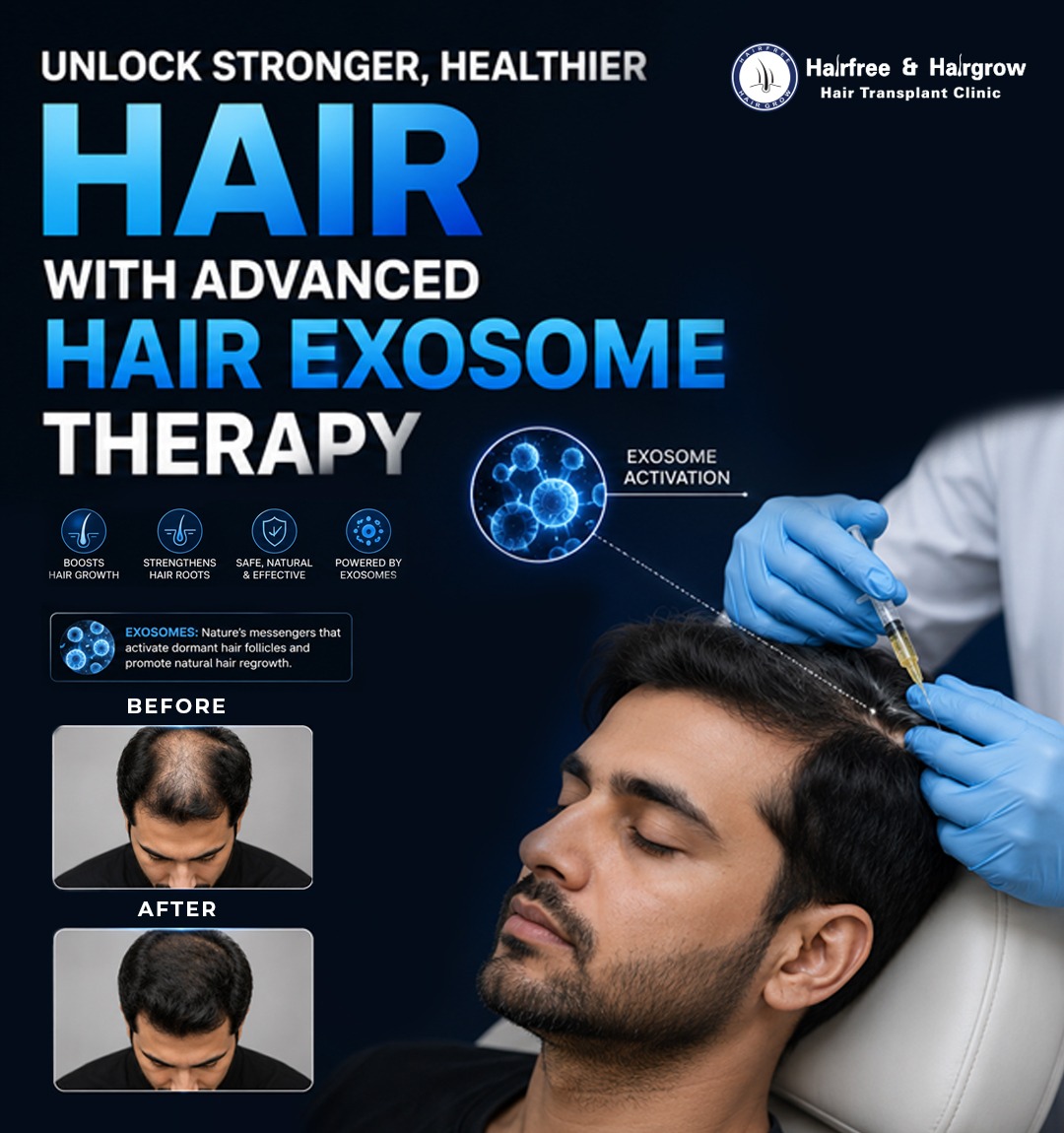
Hair loss can affect your self-confidence, appearance, and overall quality of life. Whether you are experiencing a receding hairline, a thinning crown, a widening part line, or diffuse hair thinning, early intervention may help preserve and improve your existing hair.
Exosome therapy for hair loss is an advanced regenerative treatment that uses bioactive nano-vesicles, most commonly derived from mesenchymal stem cells (MSCs), to support scalp health and encourage healthier hair growth by delivering cell-derived signaling molecules that may help improve the hair follicle environment. At Hairfree & Hairgrow Bangladesh, we provide personalized hair restoration solutions for men and women from Dhaka, Chattogram, Sylhet, Khulna, Rajshahi, Barishal, Rangpur, and across Bangladesh.
Our experienced hair restoration specialists perform a comprehensive scalp evaluation before recommending a customized treatment plan based on your hair loss pattern, age, medical history, and treatment goals.
Exosome therapy is a regenerative hair restoration treatment that uses nano-sized extracellular vesicles known as exosomes. These naturally occurring particles contain proteins, growth factors, lipids, mRNA, microRNA, and signaling compounds that facilitate intercellular communication and can influence the behavior of recipient cells by modulating signaling pathways and gene expression.
In hair restoration, exosome-based treatments are being investigated for their potential to support follicle health, reduce perifollicular inflammation, promote angiogenesis around hair follicles, and encourage dormant follicles to re-enter the anagen (growth) phase of the hair cycle. Research indicates that exosomes may activate key signaling pathways, including Wnt/β-catenin and VEGF, which support dermal papilla cell activity and follicle regeneration. Exosome therapy aims to improve the scalp microenvironment and support weakened follicles that may still have the potential to produce stronger hair.
Unlike a hair transplant, which relocates healthy hair follicles from one area of the scalp to another, exosome therapy focuses on supporting existing follicles in thinning areas.
Research in regenerative medicine continues to investigate the role of exosomes in hair restoration. Published clinical studies, including prospective trials and randomized controlled studies, have reported improvements in hair density and thickness with a favorable safety profile. While findings are promising, the evidence base is still developing, outcomes vary among individuals, and further large-scale long-term clinical research is ongoing.
When recommended for appropriate candidates, exosome therapy may help the following:
Results vary depending on individual factors, including the cause and stage of hair loss.
Exosome therapy may be considered for individuals experiencing the following:
Men experiencing early- to moderate androgenetic alopecia (AGA), characterized by progressive follicle miniaturization driven by dihydrotestosterone (DHT), may be suitable candidates for regenerative treatment approaches.
Women experiencing diffuse thinning, widening of the hair part, or reduced hair density consistent with female pattern hair loss (FPHL) may benefit from specialist evaluation to determine treatment suitability.
Patients who seek treatment early while hair follicles remain active and have not undergone irreversible miniaturization typically have more treatment options available and may respond better to regenerative approaches such as exosome therapy.
Individuals noticing reduced hair quality, thinning, or increased shedding may be suitable candidates depending on the underlying cause.
Exosome therapy may be incorporated into a broader hair restoration plan including post-transplant recovery or long-term hair loss management to support scalp health, promote follicle longevity, and maintain hair density over time.
Hairfree & Hairgrow is dedicated to providing evidence-based hair restoration solutions using advanced diagnostic technology and personalized treatment planning.
Our Expertise | What It Means for You |
Experienced Hair Restoration Team | Evaluation and treatment planning tailored to your condition |
Advanced Hair Analysis | Digital scalp assessment and trichoscopy for accurate diagnosis |
Personalised Treatment Plans | Treatment recommendations based on your individual needs |
Modern Clinical Facilities | Treatment performed in a professional clinical environment |
Transparent Consultations | Clear discussion of expected outcomes and limitations |
Ongoing Follow-Up Care | Progress monitoring and long-term hair management support |
Your treatment begins with a detailed evaluation that may include the following:
This assessment helps determine whether exosome therapy may be appropriate for your condition.
A personalized treatment strategy is developed based on
The treatment area is carefully prepared to ensure patient comfort and optimal treatment delivery.
The exosome preparation is administered into targeted areas of hair thinning using specialized techniques designed to distribute the treatment evenly across the scalp.
Most patients can resume normal daily activities shortly after treatment.
Follow-up appointments are scheduled to assess progress and determine whether additional sessions or supportive treatments may be beneficial.
Feature | Exosome Therapy | PRP Therapy | FUE Hair Transplant |
Treatment Type | Regenerative | Regenerative | Surgical |
Main Goal | Stimulate follicle regeneration and support scalp microenvironment | Deliver growth factors | Relocate healthy follicles |
Best For | Early to moderate thinning | Early thinning | Advanced androgenetic alopecia |
Downtime | Minimal | Minimal | Several days |
Surgery Required | No | No | Yes |
Donor Hair Needed | No | No | Yes |
Suitable for Extensive Baldness | Limited | Limited | Yes |
Maintenance Sessions | May be recommended | Usually required | Sometimes required |
The most suitable treatment depends on the stage of hair loss and the availability of healthy follicles.
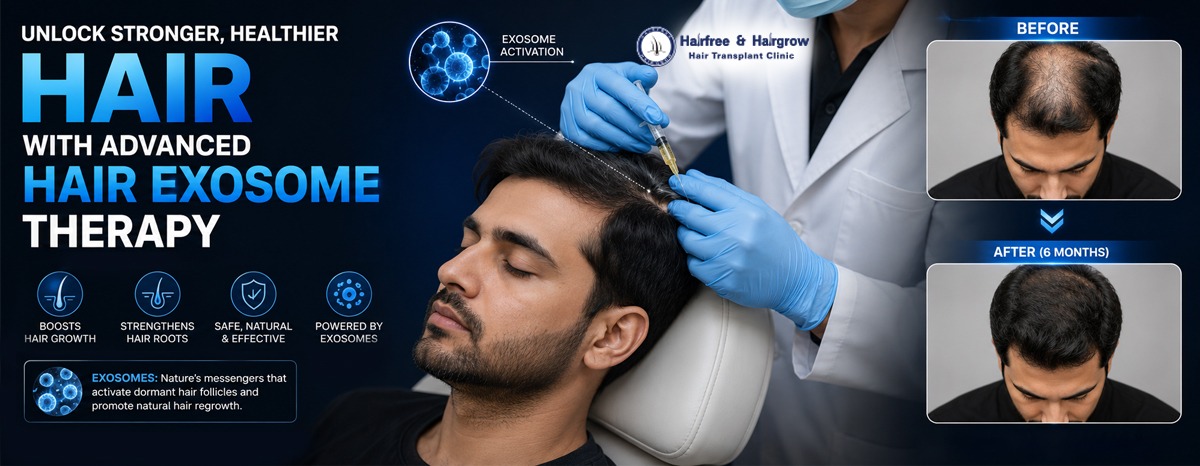
Hair growth following exosome therapy occurs gradually as follicles progress through their natural anagen, catagen, and telogen growth cycles. A full treatment response is typically assessed at 6 to 12 months.
Patients may notice:
Some patients may begin to observe the following:
Results may continue to develop as hair follicles progress through the full anagen growth cycle, which can take 6 to 12 months to complete. Maximum improvement is typically assessed at 12 months post-treatment.
Individual outcomes vary significantly, and no treatment can guarantee specific results.
Exosome therapy is generally well-tolerated when performed by qualified healthcare professionals using appropriate clinical protocols. It is important to note that exosome-based treatments for hair loss are not yet approved by major regulatory bodies such as the FDA and are considered an emerging therapy. Patients should ensure treatment is carried out by experienced specialists using products that meet applicable quality standards.
As with many scalp injection procedures, temporary side effects may include:
These effects typically resolve within several days.
Patients should discuss potential risks, benefits, and treatment alternatives during their consultation.
Treatment may not be recommended for:
A comprehensive medical assessment is required before treatment.

The cost of exosome hair therapy in Bangladesh varies depending on several factors, including:
Following your consultation, our specialists will provide a personalized treatment plan and transparent cost estimate.
Exosome therapy aims to support existing hair follicles, improve the scalp microenvironment, and encourage dormant follicles to re-enter the anagen (growth) phase. Clinical studies have reported improvements in hair density and thickness in appropriate candidates. However, outcomes vary between individuals, and no treatment can guarantee hair regrowth.
No. Patients with advanced hair loss and extensive bald areas may still require a hair transplant to achieve significant coverage.
The number of sessions varies depending on individual hair loss severity, treatment goals, and specialist recommendations.
Most patients report only mild discomfort during treatment.
Some patients notice early changes, such as reduced shedding and improved scalp condition, within 4 to 8 weeks. More visible improvements in hair density and thickness typically develop over 3 to 6 months as hair follicles progress through their natural growth cycles.
Yes. Women experiencing certain types of hair thinning may be suitable candidates following professional evaluation.
In some cases, exosome therapy and PRP therapy may be combined as part of a comprehensive hair restoration plan. Both treatments work through regenerative mechanisms, and a combination approach may be considered when clinically appropriate following specialist evaluation.
Most patients can return to normal activities shortly after treatment.
Hair loss is often progressive. Maintenance treatments and long-term management may be recommended depending on the underlying cause of hair loss.
If you are experiencing hair thinning, increased hair shedding, androgenetic alopecia, or a receding hairline, a professional consultation with a qualified hair restoration specialist can help identify the most suitable treatment options for your condition.
At Hairfree & Hairgrow Bangladesh, our specialists provide personalized hair restoration solutions designed around your hair loss pattern, expectations, and long-term goals.
Our team will assess your scalp health, discuss available treatment options, and create a customized treatment plan tailored to your needs.